Es mostren els missatges amb l'etiqueta de comentaris Euskal Herria. Mostrar tots els missatges

dimecres, 11 de desembre del 2013

What about the Spanish army?

A group of Spanish soldiers stationed at Loiola barracks in the Basque city of Donostia caused serious disturbances to nearby people on Sunday night. According to several witnesses, the male servicemen were drunk at the moment of the incidents and started shouting slogans praising former Spanish dictator Francisco Franco and also harassed sexually some women who were passing by the neighborhood next to the military establishment by showing them their genitalia. For this reason, one of them was detained by the Basque police under accusations of disobeying and resisting the authority but was lately released until the date of the trial. It is not known how many soldiers were involved in such disturbances nor whether the military or the police are about to take further actions against them. 
By its side, the mayor and the members of the city hall of Donostia expressed their anger over the behavior of the soldiers who have created a sensation of alarm and concern to the inhabitants of the city. Moreover, the city government has claimed that the attitude of the military men shows that the Spanish army is a threat to the end of the conflict in the Basque country.
Although this case can seem an isolated fact, the reality is that the Spanish army is widely known for this kind of misconduct either inside and outside the boundaries of the country. One of the most terrifying examples of that behaviour was the mistreactment that some soldiers inflicted to some Iraqi prisoners at a jail in Diwaniya in 2004. It was recorded at a video which can be watched here. However, the biggest scandal took place in the Peninsula, where a female army captain was issued a disciplinary record after she claimed that she had been sexually harassed by one of her superiors. Although the record was not apparently related to the case, the fact is that her career started worsening after the Colonel she denounced was sentenced to a prison term. The Ministry of Defence itself started the proceeding to punish the female captain.
Another remarkable fact is that lots of elements from the previous regime subsist within the military at the moment. In fact, the army was not purged after dictator Franco died and the institution still praises some of the values of the former dictatorship. As an example, the museum of the military in Toledo still treats Franco like a hero of war in spite of the crimes he and the soldiers he commanded committed. Other forms of praising the figure of the late dictator are very common among the soldiers as well, like those by the soldiers who protagonized the incidents last Sunday in Donostia.
To sum up, the behaviour of the Spanish military is not what you might expect from a security force of a democratic country. One could find dozens of examples of abuses that have been committed by those soldiers and which are not usually punished. The army would need a radical reform in Spain.


dimarts, 22 d’octubre del 2013

Justice has prevailed over revenge

Today has been a historical day for Human Rights defenders in the Basque Country, Catalonia and Spain. The European Court of Human Rights has rejected an appeal issued by Spanish government against the repeal of the so-called Doctrina Parot, a law which aimed to prevent prisoners convicted to large penalties from being released once the maximum possible sentence (30 years) they are supposed to serve has expired. Though the resolution by the ECHR is based only in a single case regarding ETA member Inés del Río, who had been eligible for early release since 2006 and applied the doctrine, nearly 60 members of the organization are likely to be released on the next months. Moreover, the sentence also determines that Del Río has been illegally jailed for nearly 7 years as her imprisonment was not due.
The Spanish High Court started applying the ruling in 2006, in order to prevent ETA member Henri Parot from being released after his maximum prison term was due. He had been convicted for carrying out several terrorist attacks and sentenced to a large penalty which legally expired that year, so the judges decided that prison benefits should apply only to the whole term instead of the maximum according to the law. Therefore, he and others who were given such sentences have remained in prison until today. In addition, the latest resolution was applied to them after once they were convicted, so it was eventually an enlargment of their prison terms.
It is evident that such decision has triggered a quite important controversy between defenders and opposers of it. For the one side, the Spanish Government, ruling party PP and main opposition party PSOE have expressed their disappointment because they think terrorism crimes will not be accuratelly punished. For instance, the government tried to put pressure on the single Spanish judge who had taken part of the resolution and stated that they would do as much as possible to prevent any attempt to "praise terrorism", while advocacy organisations like Herrira (which advocates for the end of dispersion and respect for prisoners' human rights) have been shut down and several of its members detained. Moreover, some of the victims of terrorism feel betrayed because of the sentence of the court, stating that their human rights and right to justice have not been respected. In fact, victims' organizations blame on the government for not having done enough to prevent such resolution and also request institutions and courts not to apply it.
On the other side, members from both Basque separatist left and the Basque Nationalist Party (EAJ-PNV, in Basque and Spanish), as well as other advocacy groups and Spanish leftist parties, have celebrated the court ruling as they guessed that Parot doctrine supposed a violation of prisoners' human rights. They also have requested Spanish government and authorities to apply it as soon as possible and release all prisoners whose term has expired. In addition, the abolition of the doctrine is seen as a positive contribution to the peace process in the Basque Country after ETA put an end to its armed struggle two years ago.
Regardles of the polarity that such a resolution can trigger, the fact is that Spain has been in evidence again because of the poor human rights record of the country. In fact, it has repeatedly been requested to persecute forced dissaperarances and illegal executions that had been carried out by Franco's dictatorship as well as blamed for having tortured many Basque separatists (the last accounts set that 10,000 people had been tortured since 1960), but the different governments have always turned a blind eye on these claims. However, the same people that turn a blind eye on these questions and rejects resolutions like the one issued by the ECHR claim that the possibility of holding a referendum of autodetermination in Catalonia does not respect the laws. With those reactions, it is even more clear that the Spanish concept of law is full of double standards on human rights and justice. But the fact is that, in this case, justice has prevailed over revenge.

dimarts, 15 d’octubre del 2013

"A més de per aturar els judicis, el compromís és necessari per assolir una solució integral"

Aquesta és la traducció al català d'una entrevista a 3 dels 40 joves el judici contra els quals va començar ahir dilluns a l'Audiència Nacional. Se'ls acusa de pertànyer a Segi, acusació sustentada gairebé en exclusiva en les declaracions que els acusats van fer durant la incomunicació, període en el qual molts d'ells van ser torturats. Va ser publicada al diari Berria el passat 13 d'octubre.

13-10-2013
JUDICI CONTRA QUARANTA JOVES. GARAZI RODRÍGUEZ, MIKEL ESKIROZ I AITZIBER ARRIETA. JOVES IMPUTATS EN EL SUMARI 26/11.
“A més de per aturar els judicis, el compromís és necessari per assolir una solució integral”.
Van ser detinguts, incomunicats i empresonats l’any 2009. Amb tot el que van passar, els joves han destacat que continuen treballant per assolir un altre model, fent un gest a Pamplona: “Nosaltres també hi serem”.

HODEI IRURETAGOIENA, SANT SEBASTIÀ
Garazi Rodríguez Rubio (1987), Aitziber Arrieta Fagoaga (1985) i Mikel Eskiroz Pérez (1988) han rebut BERRIA a l’”Aske Gunea” de Sant Sebastià. Manifesten clarament: “som militants polítics i socials”.

Us acusen de ser membres de Segi. Quin és el vostre delicte?
GARAZI RODRÍGUEZ: Creiem que no n’hi ha cap delicte. Aquí hi ha un conflicte polític, i estàs sota l’amenaça de ser detingut en funció de l’activitat política que duus a terme. Ens van detenir perquè la nostra activitat era contrària als interessos de l’Estat espanyol.
MIKEL ESKIROZ: No detenen militants de Segi sinó joves compromesos. És igual a quina organització pertanys.

Era el novembre del 2009. Quin n’era el context? Què volien aconseguir?
G. R.: Després de la detenció de la cúpula de Haika i Segi els anys 2001 i 2002, i més enllà de les il·legalitzacions, començaren el procés d’anomenar terroristes a tants col·lectius de l’esquerra abertzale com van voler. Després de nomenar terrorista Segi el 2007, van començar a fer batudes poble per poble, fins que el 2009 hi van dur a terme una a nivell de tot Hego Euskal Herria. Durant aquells tres anys van detenir més de dos-cents joves, molts dels quals van ser torturats i empresonats.
AITZIBER ARRIETA: No només van anar en contra de la gent favorable a un canvi de model polític, tenien hom interessat en una transformació social en el punt de mira, ja fos membre de Segi o no.
G. R.: El jovent sol ser el motor de les lluites a tot el món, i el moviment juvenil d’Euskal Herria va dir que, més enllà de respondre, emprendria el camí vers la transformació social. Això és el que volien destruir, el moviment juvenil.

Com vau viure aquell temps?
G. R.: Molts no estàvem tranquils fins i tot mesos abans de les detencions. Hi havia dues batudes al mes, força amples, i la majoria dels detinguts denunciava tortures. Et fiquen la por dins del cos. Em van detenir a mitjanit. T’agafen per sorpresa, mig adormida. Ens van torturar a tots, i també en vaig viure les conseqüències mentre era a la presó. La Garazi d’abans de la detenció i la de després no són la mateixa persona. Moltes coses no les he viscut de la mateixa manera i he necessitat ajut professional per fer-les.
A. A.: També hi són les vivències de les famílies, tant en el moment de la detenció com durant la incomunicació. Potser fa de mal dir, però arriba un moment en què els tranquil·litza que tu estiguis a la presó.
M. E.: Entra a la presó suposa que trenquis amb tota la teva vida. Quan hi surts i ho superes, arriba el judici. Amb tots els costos que suposa: viatges, l’impacte que té a la feina...

Els joves i ciutadans hi van respondre al carrer. Com us ho vau prendre?
A. A.: Sobretot, el ressò o la conseqüència d’aquesta batuda va ser, de cara a la resposta, de dir “ja n’hi ha prou”. Mentre érem a la presó vam veure la mobilització que s’havia dut a terme a Bilbao.
G. R.: Encara tens tots els moments durs que vas viure a flor de pell, però t’emociona que tanta gent surti al carrer i veus que la gent té ganes de continuar endavant.
A. A.: No han complert els seus objectius. El jovent, i també nosaltres mateixos, hem sortit enfortits i, per sort, els joves continuen treballant per assolir un nou model social i polític. No han pogut amb nosaltres.

Aquells dies se celebraven les trobades del moviment juvenil a Zestoa, i es va dur a terme malgrat tot.
G. R.: Penso que van fer la batuda aquella setmana precisament per condicionar la trobada. S’havia dit públicament: les trobades eren per unificar el moviment juvenil i posar en marxa uns objectius comuns, per construir junts un poble dels joves, perquè era palesa la necessitat d’impulsar aquesta cooperació.
M. E.: La decisió va ser important perquè la resposta no es va basar només en la denuncia. Es va seguir amb aquell model d’organització política tot i que hi havia 40 joves incomunicats i en risc de ser empresonats.

Demà començarà el judici. Com el col·loqueu en el context polític?
G. R.: La situació ha canviat molt des que ens van detenir. L’actitud i l’estratègia de l’esquerra abertzale ha canviat, també les d’altres agents polítics, socials i sindicals. ETA va dir que deixava la lluita armada. Això ha obert noves oportunitats, i ni l’Estat ni alguns agents importants s’hi han implicat. Nosaltres ens hem compromès a fer passos ves la resolució. Tots els judicis tenen el conflicte polític com a base. Ens hem de cenyir a això i fer via cap a la resolució mitjançant el diàleg. No es pot deixar en mans dels estats, ETA o els partits polítics, es necessita el compromís del poble. És lloable el que s’està fent als Fòrums Socials, per exemple. Durant anys hem sentit alguns parlant sobre el patiment, però també hi ha hagut patiment en moltes altres ocasions. Estenem la mà a tots els ciutadans, sigui quina sigui la seva ideologia. Perquè no és el moment d’estar en favor de la resolució, sinó de participar-hi. Tots plegats hem de construir un mur popular en contra de tots els atacs provinents de Madrid i París.
A. A.: També fem una crida al Govern Basc i al PNB perquè s’hi sumin al camí. Ja n’hi ha prou de fer servir les forces policials en contra d’Euskal Herria.
G. R.: Es fa front a l’estratègia de il·legalitzacions i avui ja hi ha organitzacions legals, per molt que la batuda contra Herrira ens hagi tornat a portar antigues receptes. També aconseguirem aturar els judicis, els empresonaments i les detencions si tots ens hi comprometem.

Tot plegat està basat en testimonis extrets durant la incomunicació. Quina serà la vostra actitud en el pla jurídic?
A. A.: El judici és un frau, no s’aguanta per enlloc. Tenint Segi com a excusa, només s’han de veure les proves que han presentat contra cadascú de nosaltres: mocadors de les festes, qualsevol llibre, que haguéssim participat a qualsevol concentració, qualsevol fullet... Segons això, tots hauríem d’estar a la presó.
M. E.: Segurament, aquells 100.000 joves que participaven al Topagune haurien d’estar davant l’Audiència Nacional. Aquestes detencions son molt arbitràries. El nostre poble ens ha absolt; no li reconeixem cap legitimitat a un tribunal d’Espanya.
G. R.: La Fiscalia ha presentat les declaracions davant la policia com a proves, gairebé totes fetes sota tortura. Les “proves” demostren que dúiem a terme activitats polítiques. Això no vol dir que serveixi per demostrar que érem o no militants de Segi. Això direm: tenim tot el dret de ser militants polítics i socials.

Quins objectius teniu amb Libre?
M. E.: Fins ara han treballat en favor dels drets polítics i socials. No volem renunciar-hi, però ho volem integrar a les solucions tot demanant-li compromís a la gent; no només per aturar els judicis, sinó també per aconseguir una solució integral per a tot el poble. És temps de buidar les presons, no d’omplir-les. La gent té ganes d’avançar en la resolució i viure en pau, i per tenir dret a decidir el que volem ser.

Pamplona serà la propera parada del mur popular en el camí de la desobediència.
G. R.: També fem nostre el mur popular que han construït a Iruñerria. Aquest és el camí i hem de seguir-lo. No sabem com aniran les coses. És una mala notícia que un jove més acabi a la presó. Ànims a tots els que hi sereu. Nosaltres també hi serem.

dimarts, 4 de juny del 2013

Justice "made in Spain"

Spain is about to begin a new political trial against Basque separatism. According to an information published on 3 June by Basque digital newspaper Naiz, Spanish National Court has taken another step to start the trial for the 35/02 summary against former Basque separatist party Batasuna, which was banned by former judge Baltasar Garzón in 2002. Therefore, the judge has admitted all the evidences issued by the prosecution and some by the defence, paving the way for the trial. Indeed, the court must set a date for its celebration within the next days thus ending a summary which has lasted more than ten years.
After the government banned Batasuna, former judge Garzón ordered the closure of 75 "herriko taberna" (bars of the people), a network of bars owned by Basque separatists which was allegedly linked to "ETA-KAS-Ekin" framework. He also charged 40 people on being part of the terrorist band although none of them had taken part in any violent action. Despite of that, they face lengthy prison terms if convicted. For instance, Joseba Permach, Rufi Etxeberria and Arnaldo Otegi, currently in prison, could be sentenced to up to 12 years if found guilty. The whole list of people who have been charged can be seen here (note: Basque word "urte" means "years" in English).
Simultaneously, Spanish Constitutional Court has refused to release Otegi and other four Basque politicians who are serving a six years and a half prison term whilst the appeal their lawyers issued is being resolved. They were convicted for "ETA membership, degree of leadership" for having tried to rebuild a new framework for Basque separatism through Bateragune project, whose purpose was to replace banned party Batasuna. However, the Supreme Court already overturned the verdict issued by the National Court which  sentenced them to 10 years after no evidence was found supporting the allegation that they were leading ETA although it considered that Bateragune obeyed direct orders issued by the terrorist band.
In addition, the Supreme court estimated that the four convicted were not involved in that project, so that the accusation against them has no basis. They have been sentenced for a crime that actually never existed but, in spite of that, the Constitutional court refused to suspend their prison term because of the length of the prison terms they are serving. The court also justifies this temporary resolution on the reason that victims of terrorism deserve their rights to be respected, forgeting that Basque separatist left (particularly Otegi himself) played a key role on the end of any violent activity that ETA stated in October 2011.

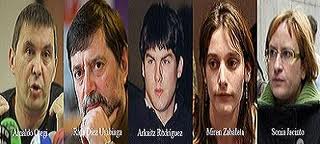
Arnaldo Otegi, Rafa Díez Usabiaga, Arkaitz Rodríguez, Miren Zabaleta and Sonia Jacinto, the 5 people who are serving lengthy prison terms for allegedly having taken part in Bateragune project.
Given all those circumstances, Otegi and the others must be released as soon as possible. Their imprisonment obeys only to political purposes and has proven totally unlawful. So do the charges against Joseba Permach and the others involved in lawsuit 35/02. Both cases are part of a strategy launched by Baltasar Garzón in 2002 whose main purpose was to link any aspect of Basque separatism or the fight for cultural and social rights for the Basque Country to terrorism. The main example was the closure of the Basque newspaper Egunkaria in 2003 and subsequent detention of its board of redaction. All the detainees were firstly sentenced but finally absolved because of the lack of evidences to support that they were collaborating with ETA. All of them claimed that they endured torture during detention. All the information regarding this case can be found in English here. On the other hand, he has been repeatedly accused of misinvestigating the complaints of detainees linked to ETA or Basque separatism regarding the way they were treated by the police during their time under custody.
Moreover, Baltasar Garzón was convicted for corruption and departed from judiciary in 2012. He had been in the middle of a huge polemic because of his intention to investigate the crimes committed by Franco's regime, gaining a lot of enemies. In fact, he has been one of the most controverted Spanish judges and, according to some rumours, he could attend next European election alongside Spanish leftist party Izquierda Unida. Meanwhile, Garzón works as the leader of the defence team of Wikileaks founder Julian Assange.
For all these reasons, nobody can deny that the current cases against Basque separatism have no legitimacy nor basis. In the case of the newest one, because it is based in the instruction made by a person who was convicted on corruption charges. Their unfairness is just an example of how justice is like in Spain.

UPDATE: the trial against Joseba Permach, Arnaldo Otegi and the other nearly 40 people involved in 35/02 summary is set to begin on 17 October, according to reports by several Basque news channels. It is likely to take place at the National Court, where alleged crimes related to terrorism are investigated. In this case, both Dignidad y Justicia (Dignity and Justice) and the Association of Terrorism Victims, which exert the accusation, claim that the network of "herriko taberna" was set to fund ETA's terrorist activities. However, the details explained above give those claims very little reliability, especially given the pressure made by both associations in order to prevent the Spanish government from taking a real commitment to help end the conflict in the Basque Country. It is just another attempt to convict people for their political activities, as well as other similar pocesses that can take place all around the world. Remember: Chinese artist and activist Ai Weiwei was accused of evading taxes, destroying accounting documents and suspected of bigamy, pornography and illegal exchange of foreign currency as well.

dilluns, 27 de maig del 2013

Europako "navajoak" eta Wert. English translation.

This is the English translation of an article written by Basque journalist Martxelo Otamendi for today's printed edition of the newspaper Berria. It is an excellent reflection on the so-called "Wert Law" and its attacks against Basque and Catalan languages, so I have decided to translate and share it.


European Navajo and Wert
By Martxelo Otamendi

The work made by the school is basic when building or destroying a people. Here and everywhere. And History has let us uncountable examples showing this, either in our own lands or in many others all around the world.  

How many schools in Basque or Catalan have French or Spanish states put along our lands, both in Catalan Countries or the Basque Country, since the public schooling system was spread a century and a half ago? Any school, neither a single classroom; even if they had put them as an experiment to prove that studying in Catalan or Basque could carry heavy mental problems... Not even for this.

During the formation of the USA, if Washington had decided to create schools in Navajo language for the students of this ethnic group, today Navajo nation could have had another strenght, and Mathematics could be taught in that language at universities along the Navajo land. But the creators of the nation, those white Europeans, those who have made history as exemplary men and women, did not commit that error. Nobody plays with the nation, and the school is the first step to make a nation change.

The same thing did France and Spain to the Navajo people of our land, to our ancestors. What happened then can be seen in the song Eskolan (at the school), by Gorka Knörr.

Eskolan dirade
gutaz trufatu
eta bortxa askoaz
hizkuntza bat ukatu.
Nik nahi dut hizkuntza bat
euskara gurea,
ez eta iñola ere
beste horiek ezarrita.

Note: this would be the translation of the lyrics:

At the school, they have
laughed at us
and by a huge violence
denied us a language.
I want a language
our euskera,
by no means
the one imposed by the others.

Spanish minister Wert, leaving aside differences, in background, is not so far from those attitudes against Navajo. The times have changed, also the methodes. Preventing it is in our hands, in Navajo's hands. The time has come to paint our faces. 

diumenge, 26 de maig del 2013

Europako "navajoak" eta Wert

Aquesta és la traducció al català d'un article publicat per Martxelo Otamendi, director del diari basc Berria, a l'edició impresa d'avui. És una excel·lent reflexió sobre la Llei Wert i els seus atacs a les llengües catalana i basca, per la qual cosa he volgut traduir-lo al català i compartir-lo.


"Navajos" europeus i Wert
Per Martxelo Otamendi

El treball de l'escola és bàsic a l'hora de fer o desfer un poble. Aquí i arreu. I la història ens ha deixat multitud d'exemples, tant als nostres pobles com arreu del món.

Quantes escoles en català o en basc han posat els estats de França i Espanya als nostres pobles, als Països Catalans i a Euskal Herria, des que implantaren el sistema d'escola pública fa un segle i mig? Cap escola, ni tant sols una aula; fins i tot com un experiment, si les haguessin implantat per demostrar els greus problemes mentals que provoca estudiar en català o en basc... Tampoc amb aquesta finalitat.

En el procés de formació dels EUA, si Washington hagués decidit implantar escoles en llengua navajo per als estudiants d'aquest grup ètnic, actualment la nació navajo hauria tingut una altra força, i s'impartirien classes de matemàtiques en llengua navajo a les facultats d'universitats situades en aquest territori. Però els formadors de la nació, els blancs vinguts d'Europa, els mateixos que han passat a la història com homes i dones modèlics, no van cometre aquell error. Amb la nació no s'hi juga, i l'escola és el primer pas per influir en la transformació d'una nació.

Això mateix els van fer Espanya i França als navajos dels nostres pobles; als nostres avantpassats. La cançó Eskolan (a l'escola) de Gorka Knörr ho recull perfectament:

Eskolan dirade
gutaz trufatu
eta bortxa askoaz
hizkuntza bat ukatu.
Nik nahi dut hizkuntza bat
euskera gurea,
eta ez iñola ere
beste horiek ezarrita.

Nota: Aquesta seria la traducció al català de la cançó:

A l'escola
s'han rigut de nosaltres
i amb molta violència
ens han negat una llengua.
Jo vull una llengua
el nostre euskera,
i de cap manera
la imposada per aquells altres.

El ministre espanyol Wert, deixant de banda les diferències, no és massa lluny d'aquella actitud contra els navajos. Els temps són uns altres, també els mètodes són diferents. Impedir-lo és en les nostres mans, en les mans de nosaltres els navajos. Ha arribat el temps de pintar-nos la cara.


dijous, 16 de maig del 2013

We shall not forget Ondarroa

A crackdown has broken up another exercise of peaceful resistance against an unfair detention, this time in Ondarroa (Bizkaia, Basque Country). Many people gathered there five days ago in order to prevent the Autonomous Police from detaining Urtza Alkorta, a woman who was sentenced to a 5-year prison term on charges of collaboration with ETA with no evidence than a self-incriminating statement she made while in custody. However, Urtza has always claimed that she and the other 6 people who were detained at the same time endured torture while in detention. In fact, they were all held incommunicado and at least one of them had to be transferred to a hospital due to the beating he suffered in the hands of Ertzaintza. Alkorta herself denounced those tortures during the trial.
Even though the most important has not been the detention itself (everyone knew it would take place despite its unfairness) but the attitude shown by the police during the eviction of the nearly 1000 people who were gathered at Alameda bridge in Ondarroa. As many as 28 police vans to detain a single person. Their deployment has been far from being peaceful or typical of a State ruled by law despite the fact that those in front of them had not been violent at any time. In fact, people of all ages were solely sitting on the ground and trying to pick each other as tightly as possible in order to prevent Ertzaintza from reaching Urtza. 
Several video footages have recorded what was going on there: police expelling elderly people from the bridge as well as showing aggressiveness against Basque MPs Maribi Ugarteburu (who has been threatened with detention for protesting the way Ertzaintza was conducting the eviction) and Laura Mintegi. However, they have been much more violent against lay people who were simply sitting on the ground and refusing to move away from the bridge. Some polices have even threatened them with rubber bullet shotguns whilst the remembrance of the death of Iñigo Cabacas (who was murdered by Ertzaintza in a crackdown on Athletic Club supporters after a UEFA match in Bilbao) is still alive among Basques. Men and women of all ages have been beaten with batons, kicked, trodden, caught by the hair. Thus there have been many wounded among protesters, also some policemen (the question is, how?) during the three hours that the crackdown on Ondarroa has lasted. 

Basque police might see an evidence of crime in this picture. By whom?
Here are some of the video footages of the most tense moments before and after the detention of Urtza Alkorta:


Some protesters shouting "that's the way they killed Iñigo (Cabacas)" whilst being targeted by Ertzaintza with rubber bullet shotguns.


Ertzaintza beating Erlantz Alkorta, Urtza's brother.


A 12 minute video of the last moments before Urtza Alkorta was detained and the first ones after her detention.

These three footages are only a sample of the police violence deployed by Ertzaintza yesterday. Those who are supposed to preserve the security and Human Rights of Basque citizens, treating their own peers in this way in order to fulfill orders issued by Madrid. Regardless if Urtza was guilty or not (a sentence based in a self-incriminating statement issued under torture should have no value), Basque autonomous police shown a shameful espectacle, much more given the circumstance that Basque society has made a commitment for peace.
I hope Ertzaintza will stop following orders by Spain and make a commitment for peace too.

dijous, 2 de maig del 2013

When torture happens in Europe: an account by Beatriz Etxebarria

«They throw a blanket on the floor. 'Commissar' shouts and tells me that they will rape me again». This is one of the most representative sentences used by Beatriz Etxebarria, a Basque political prisoner, to explain the tortures she suffered while in detention. Here is the English translation of her first hand account. The original in Spanish can be read here.

They burst my door by 4:00 AM on 1 May 2011. They catch me from the hair and take me in a twinkling to the living room. I am in bra but they do not let me put on any clothes during the registration. Once in the living room, they reduce me violently and they try to put me the handcuffs on the sofa. They get angry because they do not fit me. They tell me while I am sitting on the sofa: "you will see how you will spend the next five days".

I got a bit dizzy during the registration of the storage room. They catch me very strongly from my arm, they leave me marks. They put me handcuffs made of robe, tighter and tighter. 

While leaving home they threaten me: do not look neither talk to my partner. They lead me to the place where the car was and prevent me from looking at the registration.

They take me to the medical examiner in Bilbo: they look at me well, I have some marks on wrists because of the handcuffs, I had my veins swollen and some scratches. My arms are red because of the way they are cathing me, also stiff.

They ride me on a Patrol. They forced me to close my eyes and even blindfold me using their hands. I listen to them talking about meeting another car.

They stop the car. A Civil Guard, called himself 'Commissar', comes for me and we change the car. This time it is not a Patrol, it is a normal car considering the space and height to enter. Commissar starts to shout in my ear and to menace me: «I am military and I am trained to kill». He tells me that I have to options: to start talking since the begining or not. I notice how they take a bag and put it on my hands. During the journey to Madrid they beat me in the head and menace me constantly. They tell me that they are about to stop the car and that "I am going to undress you, I drop you to the snow and I am going to open you in canal". Commisar put his jacket out and starts scrubbing himself against my body. The other policeman beside him tries to "calm down" Commissar but also threatens me. They make me "the bag" (a technique of torture consisting in applying a bag to the detainee in order to make him think he is choking)  twice on our way to Madrid.

There are two different rooms inside the commissariat: from the first I heard the screams of the rest of detainees, but there was another below which I had the feeling it was isolated, the treatment there was even worse. I will call the first "harsh room" and the other "very harsh room".

The menaces go on and Commissar gets me into a cell and tells me to think well what I am going to do. They get me out the cell and take me to the medical examiner.

It is Tuesday at around 20:30. I tell him that I am being tortured. Then, they get me back into the cell.

I am transferred to the "harsh room". Once there, I could heard the screams of the rest of detainees. They sit me down in a chair and wet my hands, whilst I hear a noise of something like electrodes. When I was inside the cell I heard he same noises. They tell me that I must talk and start undressing me until I am totally naked. While naked, they throw cold water on me. They put me "the bag" on until three times more. They threaten me with making me "the bath" (another technique which consists in putting the head of the detainee inside a bath full of water so that he feels choking). While naked, I am put on all fours on a sort of stool. They put vaseline into my anus and vagina and start introducing me an object. I am still naked and they wrap me with a blanket and beat me. I am caught, buffeted and finally raised from the floor.

They take me back into the cell until Wednesday morning, when I visit the medical examiner again. I tell he something about the treatment I was undergoing but and his reaction was bad.

I come back to the cell and then I try to "rest" a bit. After a while, Commissar comes and takes me to the "very harsh room". Once there, they undress me again. He pulls my hair, beats me on the head and shouts in my ear that he is a military and he has been trained to kill and "I will shatter your inside so that you cannot have little terrorists".

They bring me back to the cell and, after being there, to the medical examinator. I tell him nothing after seeing that during the last visit he questioned the account on tortures I had suffered.

There were many people during the questioning. Once I counted to seven different voices. They threaten me constantly with my partner (to whom I listened that he was being tortured). They also menace me with detaining my brother. They tell me that, if there is not any treat, they will detain not only my parents, but they will also take my grandmother "in panties and that he will fuck her".

The penultimate day, Commissar undresses me again. He throws a blanket on the floor, shouts and tells me that they will rape me again. I get the impression that he starts putting his clothes off, I hear how he removes his belt. Then, a man who is referred to as Garmendia tries to calm him down, he gets him out of the room where they were and I hear how they talk. Garmendia enters the room again and makes me promise that I am going to declare.

I had until six questionings the last day. I made my second policial statement on Saturday at around 5:40 AM. After that they do not undress me again and are less aggressive, they even told asked me if I wanted to see Iñigo (her boyfriend).

The threats did not cease until we arrived in the National Court. Inside the van, Commissar, who was sitting besides me, told me that I had to ratify my statement before the judge.

During all the incommunicado period, except when visiting the medical examinator, I staid blindfolded with different masks. There were some made by latex with a sort of dust which could make me blind if I opened my eyes, according to them. I noticed that when they removed it my eyes itched for a while. When I was with Commissar, they put me another mask made by something like velvet.

During the incommunicado period I was mainly with three policemen (Commissar, Inspector and Garmendia, who was less savage), althought there used to be many people in the room during the questionings.

Before the judge I denied the statement I had made to the police and denounced that I had been tortured.

dilluns, 29 d’abril del 2013

Unforgettable Gernika

It was early in the afternoon of 26 April 1937. As every Monday, it was a Market day in Gernika, so the main square of the city was busy. Up to 10,000 people, many from nearby villages, gathered there at a trade fair dedicated to cattle and crops. The fair supposed an increase in the population of the city, which had about 5,500 inhabitants then. In addition, some of the Republican and Basque troops and refugees had been stationed there on their way to Bilbao, fleeing from other parts of the Basque Country.
The alarms that warned of a possible bombing strarted ringing at about 4.30 PM. A single German Dornier Do-17 arrived there from Burgos airport, making two passes in which it dropped about 12 50kg bombs. Some of them reached San Juan church and hit the promenade area called "Paseo de los Tilos" (Lime Walk, in English). Then, three Italian Savoia-Marchetti planes appeared entering Gernika from the sea, which had the commitment to bomb Renteria bridge in order to cut off the retreat of the Republican and Basque troops. However, they failed this objective because of the heavy wind. In spite of that, some bombs reached Izquierda Republicana headquarters. Until that time, the damages significant but limited only to a few areas in the city centre and near Oka river. In fact, the artifacts used since were indicated to hit specific objectives.
The heaviest bombing came later that afternoon. A Heinkel He-111, escorted by five Fiat Cr-32 fighters, came along and tried to bomb the bridge again. At about 6.00 PM, three squadrons of Junkers Ju-52 appeared in the horizon, attacking Gernika from North to South following the railway. As many as 19 airplanes, surrounded by German and Italian fighters, dropped more than 20 tons of bombs, most of them incendiary. They caused the subsequent fire. Because of the heavy smoke provoked by the bombing, they ended up throwing their bombs blindly, which contributed to the destruction of the town.
But the worst was still to come. Once the bombing finished, some planes from the Nazi aircraft started flying at low altitude over Gernika and started strafing people who were fleeing from the bombs. After more than 3 hours of heavy bombing, the alarms stopped ringing at 7.30 PM. Almost all the buildings of the town centre and the area surrounding the railway were burning due to the thousands of incendiary bombs which had been dropped over there. Ironically, Renteria bridge, which was the most important militar objective, remained untouched, as only 1% of the buildings there. According to the latest account, there were around 250 casualties and many other wounded.
The video below shows first hand accounts from Carmen Egurrola, Lidia Abadia and Cornelio Totorikagoiena, three Basques living in Boise (Arizona) who experienced the devastation of their homes by Nazi aircraft in 1937.


Although it was not the first time that an open city had been a military objective, the destruction of Gernika acquired a special symbolism after British journalist George Steer (born in South Africa) wrote a chronicle on the bombing after visiting it on the same day. He was astonished by the scenario he found there. He published an account of everything he saw there in some important newspapers such as The Times and the New York Times. Thus his narration arrived to hundreds of readers and politicians from the United Kingdom, the United States and France, contributing to create a myth regarding the town. He also was determinant to disprove the Francoist propaganda, directed by Luis Bolín, whose aim was to claim that Gernika had been burnt by Basque militians on their retreat. Alongside Picasso and his Guernica, the chronicles written by Steer made thousands of people from all around the world be aware of what was going on in Spain and the German and Italian intervention in the Spanish Civil War.
In addition, the destruction of Gernika was symbolic because it was almost the first time that the bombs destroyed an open city, away from the front. But its greatest importance lies in the fact that it had been the place where the Batzar Nagusiak (a representative assembly which legislated and ensured that the State would respect the foral privileges) of Biscay gathered under the Tree of Gernika from the 14th Century until they were abolished in 1876. Ironically, the Parliament House and the surrounding area were the least affected and both the building and the oak tree stand in the same place 76 years after the town was devastated. 
Furthermore, it is well known that Franco himself ordered the destruction of such an important symbol for all the Basques and the Condor Legion simply did their bidding. So that, Francoist troops could not deny that they knew every information regarding those events. It was accurately planned despite the attempts to present it as a fire caused by Basque troops in order to destroy the city and thus accuse the rival faction. However, nobody in the Basque Country could believe this hypothesis.
As well as the tragedy of the bombing itself, the destruction of Gernika and the following occupation of the surrounding area  provoked the demoralisation of Basque people and opened the way to Bilbao and the metal industry. But this would not be its latest effect: three days later, Basque writer and poet Estepan Urkiaga, Lauaxeta, was detained while he was visiting the city with a group of journalists. He was a true supporter of the Basques and exercised as a political commissar for the nationalist party EAJ, which had the local authority in the Basque Country. He would be jailed and executed two months later despite the efforts to avoid his death.
The destruction of Gernika marked the recent history of the Basque Country alongside the effects of the subsequent dictatorship, but also became a symbol for everyone who was against the war and a signal which allowed people from all around the world foresee what would happen during the Second World War. That is the reason why nobody should forget what happened there 76 years ago.

divendres, 19 d’abril del 2013

The end of a dream which lasted too short

Six people from the Basque city of Donostia have been finally detained due to political reasons. Oier Lorente, Egoi Alberdi, Mikel Arretxe, Aitor Olaizola, Ekaitz Ezkerra and Adur Fernández were the detained, after Naikari Otaegi and Imanol Vicente refused to participate in the so-called "Aske Gunea" (Space for Freedom, in Basque). More than 800 people were alongside them awaiting the security forces after the Spanish National Court ordered their detention last Monday.
The only crime of Egoi, Imanol, Oier, Adur, Mikel, Aitor, Ekaitz and Naikari was their involvement in a Basque separatist organization called Segi, which is considered "terrorist" by Spain despite its merely political activities. For more details regarding their case, please read my post «There are no political prisoners in Spain», written on 10 April.
Some video footages of their detention show a violent attitude of the Ertzaintza towards the hundreds of people who gathered at the Boulevard of Donostia. Furthermore, the police had even menaced those who opposed the detentions with "legal or administrative consequences", according to a video broadcasted by the same police that has been released by Naiz digital newspaper. 


Meanwhile, all the media who were covering the event have been expelled from the area where the gathering was taking place. Ertzaintza have even attacked the Basque journalist Lander Arbelaitz from Argia weekly magazine, despite he was carrying his accreditation and shouting that he was a journalist. He has been able to record the aggresive behaviour of the police in the following video. He also has written a chronicle of these tense moments on his personal blog (in Basque).


The crackdown by Basque police and the following detentions came after three days of peaceful resistance by hundreds of people who gathered at the Boulevard in Donostia, close to the city hall. Lots of them also staid there at night, reaching numbers of more than 800 last night and up to 2,000 yesterday afternoon. They gathered there in order to protect the 8 convicted in every moment, night and day. There were mainly young people, organizating different activities such as concerts or poetry reading. Furthermore, it has been a magnificent example of peaceful struggle and civil disobedience which prevented their detention twice before it happened today. At the third time, Ertzaintza started removing demonstrators one to one, while those who still remained at the site of the protest lied on the ground and peacefully resisted the police. However, security forces cracked down on some of them violently and detained 2 more people for having resisted the authority. The next video shows the last 20 minutes of Aske Gunea, until the 6 youths have been detained.


Even though many of us have not been able to be there and show our solidarity with these 8 young boys and girls, to follow those events throught the media and social networks has been very touching. They have been finally detained, but the record of this experience will remain for long. What happened in Donostia was more than a gathering in support of people having been unfairly sentenced to lenghty prison days. It was a proof of the strenght of Basque society's commitment for non-violence. We will remember what happened there as an example of resistence against repression, political trials and the lack of human rights. Nevertheless, the struggle for peace and freedom in the Basque Country will last for long, as the Spanish state does not show any willingness to end this kind of abuses against human rights. Despite all the obstacles, peace, democracy and human rights will win.

dijous, 18 d’abril del 2013

«Agur ama», a letter by a Basque political prisoner

This letter was written by Basque political prisoner Francisco José Ramada Estévez, "Bera" and released in Spanish by Basque newspaper Gara on 18 April 2013.

You are gone with the warmth of a land to whom you came from the countryside in Zamora looking for opportunities and which you learnt to love.

We could not say goodbye to each other this time, I could visit you at the geriatric nine months ago. But not now, althought the judge gave me permission to visit you fifteen days ago. I would be able to say goodbye, but it was impossible. I know that you were waiting for me until the last moment, until you faded the last breath of your life. You know that my tears flooded me when I was given the news, not for weakness but of anger, but also of pride for being son of this wonderful land. Because despite the vindictive, arbitrary and cruel prison policy which prevented me from receiving your last kisses, friends from Ataun such as Martxel, Patxi, Karmele, Xabi, and others from Irun like Alberto, Mattin, Manolo, Fernando, or those from your religious community such as Javier, who has been like one of the family, and lots of friends more could give you my last goodbye between sounds of txistu and guitars from your religious community singing "Agur Jaunak", whose notes sounded inside me while I was being brought handcuffed in a van traveling the roads of Spain. Someday we will start our way back alongside the end of a dispersion which moves us away from our loved ones, it will be like you wanted when you voted Bildu so that they brought us all back home.

The warmth that dozens of friends from Ataun and Irun gave me at the door of the Juncal church in Irun, with shouts of support that touched me, was comforting. Also in the sacristy, when I could be with my sister Mari Mar and my nephews after all these years. As also hug many friends I had not seen for many years, so many that there were some who I did not recognize, so I apologize. And in every moment, inseparable with my tireless and beloved partner Mila who, althought being at home, continues jailed. Not even a minute we parted, together at any time and, even during the mass, she comforted me with her love in all those difficult moments. In short, that you are gone with the warmth of a land to whom you came from the countryside in Zamora looking for opportunities and which you learnt to love. Despite the difficulties of life you never lost your optimism, despite your poor health you made huge effort to visit me in Granada or in Castellón because you wanted to have me with you. Despite all your efforts, I always found your laughter and the brightness of your eyes. Because the desire to live was overwhelming in you. So that you have struggled for live until the last moment. Now you rest caressed by the wind of Cantabric sea which slips in and transmits you my kisses. Do you know, ama1? Sooner than later we will walk through the streets of our freed fatherland, this day I will bring you flowers and we will talk.

In these cold nights in my cell I am accompanied by the memories of my chilhood in Bera, the image of Aiako Harria2 from the balcony of our house in Ilekueta and the whispers of the Altzate stream which bring me your voice to relieve your lack.

Well, ama, I thus say you goodbye, by letter, because they have not let us any other option. I know that I will be able to visit you soon and bring you the first spring flowers. Until that day.

Eskerrik asko Ataungo eta Irungo lagunei3.

1Ama is the Basque name for mother.
2Aiako Harria is a massif east of Oiartzun in the Basque Country. Bera is close to it.
3It means “thanks to my friends from Ataun and Irun”, in Basque.


dilluns, 15 d’abril del 2013

Their lives are more valuable than ours.

Spanish newspaper El Mundo has released today a reportage on Luis Morcillo, a former GAL member who claims that he murdered Santi Brouard, a Basque paedriatician and former head of the separatist party Herri Batasuna, on 20 November 1984. He had never been convicted for this crime, after a court in Bizkaia issued a lawsuit in which he was absolved due to the lack of proofs. So the assassination has gone and will go unpunished due to a legal principle which establishes that either crime cannot be prosecuted twice.
According to his own statement, Morcillo commited the murder when Brouard was leaving his consulting room in Bilbao. He and Ramón López Ocaña shot the doctor twice and then finished off him while lying on the floor. After that, Luis and Ramón ran away from there and left the gun in the stairwell. The so-called GAL terrorist group claimed the attack hours later. After that, Morcillo was helped to flee Spain and headed Venezuela and Colombia, where he worked as a member of security staff of the chief of Cali drug cartel.
The single reason for this assassination was that Brouard was a member of Herri Batasuna, a Basque separatist and socialist party. In fact, he was imprisoned in 1983 for allegedly singing the Basque fighters' song Eusko Gudariak during a visit of the king of Spain. He even was aware that State-terrorist groups like GAL had targeted him because of his political activities but decided not to stop his work as a doctor neither to flee the Basque Country.
The most astonishing fact of this sort of crime is that it was entirely politically motivated. Furthermore, it counted with the authorization of the Spanish Interior Ministry. In fact, both López Ocaña and Morcillo were paid about €45,000 for the attack. Moreover, the person who ordered the murder was Rafael Masa, commander of the Spanish police Guardia Civil at the time. He was likely to have acted under instructions of Julián Sancristóbal, a former director of State Security. So that, Spanish authorities knew and even encouraged the murder, which can be qualified as a State crime.
The death of Santi Brouard did not happen neither in a country like China nor in an African State but in Spain. Despite the efforts to banish either relationship between GAL and the State, the truth is that any crime committed by the terrorist organization could not have taken place without the support of the authorities. Furthermore, only a few people have ever been sentenced for State-related violence. Thus it is clear that those actions had a political motivation: to exterminate Basque separatism through a sort of "dirty war", using the crimes committed by  terrorist group ETA as a justification. They were deployed together with tortures at Basque and Spanish prisons. Most of these actions have never been investigated nor condemned.

dimecres, 10 d’abril del 2013

«There are no political prisoners in Spain»

Two days ago, on 2 April, the Spanish High Court upheld a sentence issued by the National Court in which 8 young separatists were sentenced to a prison term of 6 years whilst 7 others were absolved. They were convicted for allegedly being part of a "terrorist organization". There were no more prove than declarations made under torture and some personal items that police found at detainees' homes, such as DVDs and banners of SEGI, a Basque youth independentist movement in which they were involved according to the ruling issued by the court.
Though Segi has been labelled as a terrorist organization by the Spanish goverment (they blame it for being ETA's youth movement), none of the convicted has been sentenced for commiting violent actions such as "Kale borroka". In fact, the court was only investigating them for their political activities as members of this separatist group also linked to Abertzale left. However, those absolved are being investigating for their supposed participation in violent protests.
Moreover, Basque autonomous police Ertzaintza has implemented a crackdown this morning on the 8 recently sentenced and people who had gathered in Donostia to support them close to the city hall, beating some of the demonstrators. They have finally detained Ekaitz Ibero, one of the absolved who had been previously convicted for his supposed participation in actions of Kale Borroka.


Whereas Spain continues claiming that there are no political prisoners in the country, politicians like Arnaldo Otegi remain in prison for his exclusively political activities. He and other 5 people were sentenced to long jail terms (initially 10 years, but their prison term was reduced to 6 years after an appeal) for their will to rebuild a Basque separatist political party amidst the so-called Bateragune lawsuit. Furthermore, some Basque independentist parties like Sortu have been recently legalized and allowed to concur at elections. In spite of that, these parties are often threatened with illegalization in application of a law dated from 2003 to prosecute any political formation allegedly tied to ETA.
What is more, the crackdown in Donostia follows a series of beatings and claims of torture by some Basque prisoners linked to the terrorist group, who have been applied harsh prison terms and frequently harassed for being involved in ETA. Moreover, two prisoners have recently death while serving their jail terms, one of them, Xabier López Peña, in strange circumstances. In fact, they are often forced to serve their terms in jails outside the Basque Country, which commits their relatives and friends to make long and sometimes dangerous journeys for a 40-minute visit. Thus it causes a great pain not only to the prisoners, but also to their families. Gari Garaialde explained graphically the meaning of dispersion in this video on one of his journeys from Zarautz (his hometown) to Alacant prison.


Given all these circumstances, no one should be able to deny that there are Basque political prisoners in both Spain and France. They are treated different from others for the crimes they have commited, so even the security forces and authorities give them a political reason. That is something which has to change so that Basques can build a durable peace and a scenario of convivence, thus rebuilding a society which has been involved in a political conflict for decades.